


Split Cell (I.D. = 10 mm, PEEK & Ceramic) for Operando EC-MS (or DEMS) Characterization of Solid-State Battery, CSSBMSSP
Use your own shipping account?
We support FedEx, UPS, and DHL third-party billing for institutional customers.
Place your order first, then email shipping@echemsupplies.com with your account details and order number. We'll generate the label using your account and refund your shipping charges, less a handling fee.
Add-Ons


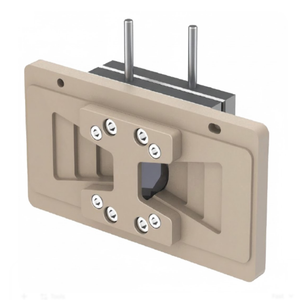

An operando Differential Electrochemical Mass Spectrometry (DEMS) or Electrochemical Mass Spectrometry (EC-MS) split cell for solid-state batteries (SSBs) must solve a dual engineering challenge: applying uniform, high uniaxial stack pressure (typically 1–100 MPa) while maintaining a low-dead-volume, hermetically sealed gas sampling channel.
The main features of the operando testing cell are: (1) Mechanical Pressure Coupling: Unlike liquid cells, solid-state cell stacks (Cathode / Solid Electrolyte / Anode) require external pressure to maintain intimate contact. The plunger system must transfer mechanical loads from external torque bolts or hydraulic/pneumatic springs without shearing sealing gaskets or crushing the gas manifold. (2) Dead-Volume Minimization: Gas release in SSBs (e.g., O2, CO2, SO2, H2S) is often orders of magnitude smaller in volume than in liquid electrolytes. Minimizing internal headspace (< 0.5 mL) and sweeping with high-purity inert carrier gas (He or Ar) is essential to achieve sub-second MS response times and prevent peak broadening. (3) Gas-Permeable Current Collector: The working electrode interface needs a porous or perforated current collector (e.g., micro-machined stainless steel grid, porous Ti/Au sinter, or laser-drilled mesh) that allows evolved gases to escape directly into the carrier stream while maintaining uniform current and pressure distribution. (4) Chemical / Electrochemical Inertness: Cell bodies are typically machined from high-performance thermoplastics (PEEK, PTFE) with high-grade stainless steel (316L) or titanium plunger contacts to withstand high anodic potentials and corrosive decomposition products (such as H2S from sulfide electrolytes or halogens from halide electrolytes).
| Part Number |
|
| Structure/Components |
|
| Cell Sizes |
|
| Max. Operation Pressure |
|
| Assembling Instructions |
|
| Note | The cell components should be thoroughly cleaned and dried after use. |


References:
- W. Tu, et al., Gas Evolution Analysis of Sulfide-Based All-Solid-State Li-Ion Battery, Nano Lett. (2025) 25 (30): 11723–11730.
- A. A. Delluva, et al., Decomposition of Trace Li2CO3 During Charging Leads to Cathode Interface Degradation with the Solid Electrolyte LLZO, Adv. Funct., Mater., 2021, 31, 2103716.